
Upper abdominal ultrasound is a first-line imaging exam for the assessment of the abdominal organs. It is simple, quick and non-invasive, allowing real-time visualization of structures such as the liver, gallbladder, pancreas, kidneys and spleen. Because it does not use radiation, it is considered safe at all ages, including in pregnant women and children.
What is an Upper Abdominal Ultrasound and what is it for?
Upper abdominal ultrasound uses high-frequency sound waves emitted by a probe, which pass through the tissues and are reflected, generating detailed images of the organs.
At X-Clinic, ultrasounds are performed with the latest technology, using high-end High-Resolution Digital Ultrasound equipment, including three-dimensional technology and real-time 3D visualization – 4D, Color Doppler, and panoramic imaging.
It is a painless and harmless technique, indicated to:
- Assess the liver, pancreas, gallbladder, kidneys and spleen;
- Investigate abdominal symptoms such as pain, nausea or distension;
- Identify structural changes in internal organs;
- Support the early diagnosis of diseases of the digestive and urinary systems;
- Monitor the progression of known conditions.
How much does an Upper Abdominal Ultrasound cost?
The price of an upper abdominal ultrasound is €60 on a private basis. However, X-Clinic has the following agreements:
- ADSE (the patient only pays the co-payment of €8), ADM GNR, SAD PSP;
- Insurance companies: Médis, Multicare, Advance Care, Allianz, Saúde Prime, Future HealthCare, SS CGD, SAMS Quadros, SAMS, Montepio, RNA, Generali, Mudum, MGEN, Aegon, Vitória, Una Seguros, other insurers;
- Health Plans: Medicare, Saúde Prime, Future HealthCare, Continente Wells, ACP, other health plans.
The final price varies depending on the healthcare system or insurance you wish to use.
How is it performed?
During the ultrasound, the patient lies on an examination table in a dimly lit room to make it easier to see the images. The doctor applies a transparent gel to the skin of the abdomen, which allows proper transmission of the sound waves and helps the probe to glide smoothly.
The images are obtained in real time and assessed by the imaging specialist. The exam usually lasts between 15 and 30 minutes.
What does it detect?
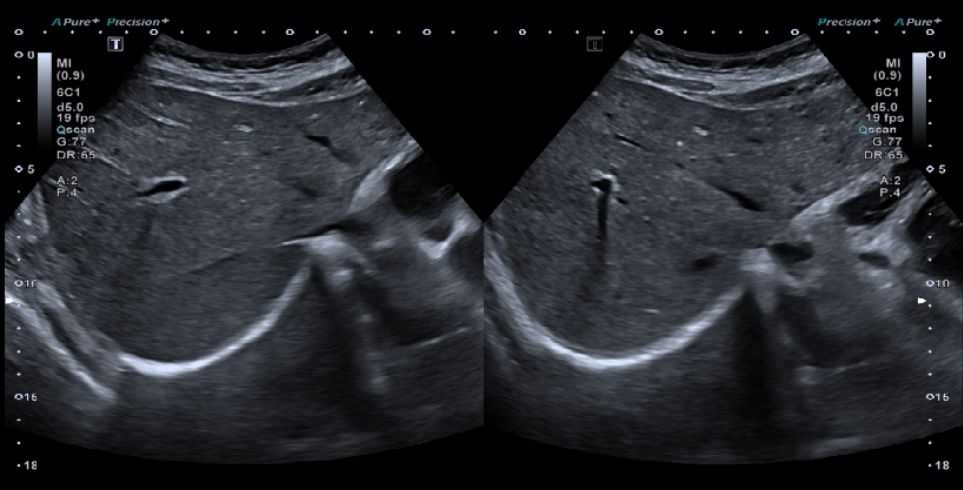
Upper abdominal ultrasound allows detailed observation of different organs and structures in the abdomen. It is useful for identifying changes in the liver, such as cysts, nodules or signs of diffuse liver disease, and for assessing the gallbladder, detecting stones (gallstones) or inflammation. It also enables the study of the pancreas, revealing masses or inflammation, as well as the spleen, checking its size and possible lesions.
In addition, it can identify dilatation of the biliary or urinary tracts, free fluid in the abdomen and vascular changes using Doppler. This exam is often the first step in the investigation of abdominal symptoms and is also essential in the follow-up of chronic diseases and in monitoring after abdominal surgery.
In which cases is it indicated?
Upper abdominal ultrasound may be requested in several situations, such as:
- Persistent or sudden abdominal pain;
- Nausea, vomiting or digestive changes;
- Abdominal bloating or increased abdominal volume;
- Suspected gallbladder or kidney stones;
- Assessment of liver changes such as cysts, nodules or chronic liver disease;
- Investigation of abdominal masses or tumors;
- Monitoring of chronic liver, pancreatic or kidney diseases;
- Postoperative assessment after abdominal surgery;
- Among others.
Preparing for an Upper Abdominal Ultrasound
You must fast for 6 hours before the exam (do not eat solid food). During this period, you may drink small amounts of water if necessary, but you should avoid sugary drinks, fizzy drinks or coffee.
You should continue taking your usual medication as normal.
Wear clothing that makes it easy to access the area to be examined.
You should also bring previous exams (ultrasounds, tests or clinical reports) and the exam prescription.
Where to have it done?
Abdominal ultrasound can be performed at X-Clinic (Av. Eng. Duarte Pacheco, nº26 – mezzanine floor, 1070-110 Lisbon) or at NRD (Avenida Columbano Bordalo Pinheiro, nº 11-B, ground floor, 1070 – 060 Lisbon – next to Praça de Espanha)
