
Gynaecological ultrasound (or pelvic ultrasound) allows the uterus, ovaries, Fallopian tubes and other pelvic structures to be examined in a safe, quick and non-invasive way. It does not use ionising radiation, making it suitable for all ages and also for pregnant women when clinically indicated. It can be performed endocavitarily or suprapubically.
What is a Gynaecological (or Pelvic) Ultrasound and what is it for?
Gynaecological ultrasound uses high-frequency sound waves emitted by a probe, which travel through tissues and are reflected back, creating real-time images of the pelvic region.
At X-Clinic, ultrasounds are performed with the latest technology, using High-Resolution Digital Ultrasound equipment, including three-dimensional technology and a real-time 3D viewing option – 4D, Colour Doppler, and panoramic imaging.
Gynaecological ultrasound is simple, safe, harmless and painless, and is used to:
- Assess the uterus, endometrium, ovaries and Fallopian tubes;
- Identify cysts, fibroids, polyps or pelvic masses;
- Monitor the progression of gynaecological conditions;
- Support fertility assessment and treatment monitoring;
- Clarify symptoms such as pelvic pain, menstrual irregularities or abnormal bleeding.
What is the price of a Gynaecological / Pelvic Ultrasound?
The price of a gynaecological / pelvic ultrasound is €50 as a private patient. However, X-Clinic has the following agreements:
- ADSE (the patient only pays a co-payment of 7€ e 8€), ADM GNR, SAD PSP;
- Insurance companies: Médis, Multicare, Advance Care, Allianz, Saúde Prime, Future HealthCare, SS CGD, SAMS Quadros, SAMS, Montepio, RNA, Generali, Mudum, MGEN, Aegon, Vitória, Una Seguros, other insurers;
- Health Plans: Medicare, Saúde Prime, Future HealthCare, Continente Wells, ACP, other health plans.
The final price varies depending on the healthcare system or insurance you wish to use.
How is it performed?
Gynaecological ultrasound can be performed in two ways:
- Suprapubic (transabdominal) approach: the probe is placed on the skin of the lower abdomen after applying a gel that improves the transmission of ultrasound waves. Learn more at Suprapubic Pelvic Ultrasound.
- Endocavitary (transvaginal) approach: the probe is inserted into the vagina, allowing a closer and more detailed view of the uterus and ovaries. This probe is inserted with a disposable cover and a small amount of lubricating gel at its tip, to facilitate insertion and improve image transmission. Learn more at Transvaginal Pelvic Ultrasound.
During the exam, the patient lies on an examination couch in a dimly lit room to facilitate image reading. Moving images are viewed in real time on a screen and interpreted by the specialist doctor. The procedure usually lasts between 15 and 30 minutes. 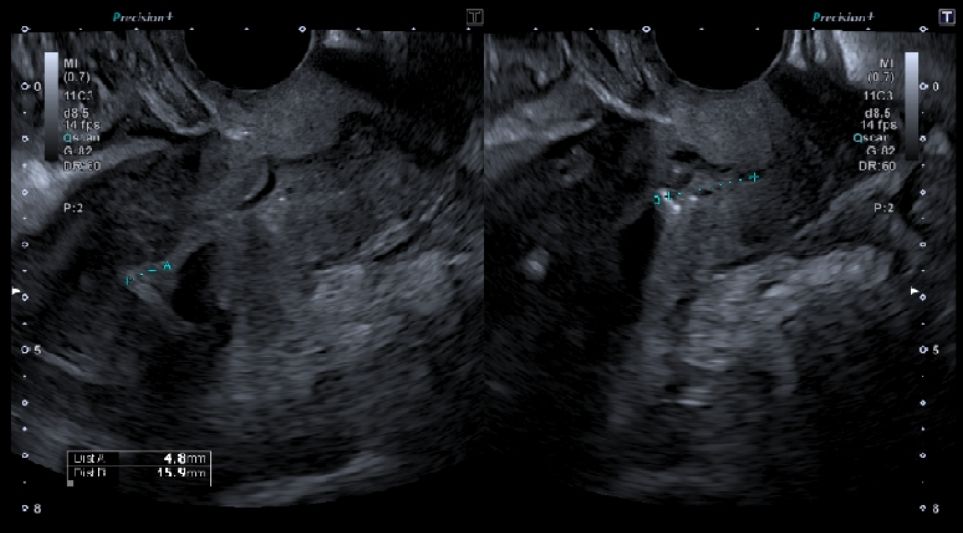
What does it detect?
Gynaecological ultrasound is a key exam for assessing a woman’s reproductive and gynaecological health. It can identify changes such as uterine fibroids and endometrial polyps, ovarian cysts (functional, haemorrhagic or pathological), and endometrial variations, whether due to thickening or atrophy. The exam also helps detect uterine malformations, congenital anomalies, signs of endometriosis or pelvic inflammation. The Fallopian tubes may also be evaluated, particularly in cases of dilation or obstruction, and, through Doppler, it is possible to study pelvic blood flow. In addition to diagnosis, this ultrasound plays an important role in fertility treatment follow-up, monitoring response to hormonal therapies, and post-surgery surveillance.
In which cases is it indicated?
Gynaecological ultrasound may be indicated in various situations, such as:
- Chronic or acute pelvic pain;
- Abnormal uterine bleeding or menstrual irregularities;
- Infertility assessment;
- Follow-up of fibroids, cysts or endometriosis;
- Endometrial monitoring during hormonal treatments;
- Post-surgical evaluation or gynaecological complications;
- Routine exam for screening or gynaecological surveillance;
- Among other situations.
Preparation for a Gynaecological / Pelvic Ultrasound
Preparation depends on the technique chosen for the exam:
- For suprapubic gynaecological ultrasound, it is recommended to drink 1 litre of water one hour before the exam without urinating, so that the bladder is full, making it easier to visualise the pelvic organs. Learn more at Suprapubic Pelvic Ultrasound.
- For transvaginal ultrasound, no specific preparation is required.
In either case, bring previous exams (ultrasounds, tests or clinical reports) and the exam prescription with you.
Where can you have it done?
Gynaecological Ultrasound can be performed at X-Clinic (Av. Eng. Duarte Pacheco, no. 26 – intermediate floor, 1070-110 Lisbon) or at NRD (Avenida Columbano Bordalo Pinheiro, no. 11-B, ground floor, 1070-060 Lisbon – near Praça de Espanha)
