
Musculoskeletal ultrasound, also called joint ultrasound or osteoarticular ultrasound, is an imaging exam used to study the various joint structures such as the shoulder, knee, elbow and ankle, as well as muscles, tendons, ligaments, bursae, synovial membranes and menisci. It is simple, quick and non-invasive, allowing precise identification of a wide range of lesions and changes in the musculoskeletal system.
What is an Osteoarticular Ultrasound and what is it for?
Osteoarticular ultrasound uses high-frequency sound waves emitted by a probe, which pass through the tissues and are reflected, forming real-time images of the structures being assessed.
At X-Clinic, ultrasounds are performed with the latest technology, using high-end High-Resolution Digital Ultrasound equipment, including three-dimensional technology and real-time 3D visualization – 4D, Color Doppler, and panoramic imaging.
Osteoarticular ultrasound is safe, harmless and painless, and is generally indicated to:
- Study joints such as the shoulder, knee, elbow, wrist, ankle and hip;
- Assess muscles, tendons, ligaments, bursae, menisci and synovial membranes;
- Investigate pain, swelling (increase in volume of a body part) or functional limitation in joints;
- Support the early diagnosis of musculoskeletal injuries;
- Monitor the progression of rheumatic or traumatic diseases.
How much does an Osteoarticular Ultrasound cost?
The price of an osteoarticular ultrasound is €60 on a private basis. However, X-Clinic has the following agreements:
- ADSE (the patient only pays the co-payment of €8), ADM GNR, SAD PSP;
- Insurance companies: Médis, Multicare, Advance Care, Allianz, Saúde Prime, Future HealthCare, SS CGD, SAMS Quadros, SAMS, Montepio, RNA, Generali, Mudum, MGEN, Aegon, Vitória, Una Seguros, other insurers;
- Health Plans: Medicare, Saúde Prime, Future HealthCare, Continente Wells, ACP, other health plans.
The final price varies depending on the healthcare system or insurance you wish to use.
How is it performed?
During the ultrasound, the patient is positioned lying down or seated, depending on the joint being studied. The exam is performed in a dimly lit room to facilitate reading of the images. The doctor applies a transparent gel to the skin over the area being assessed, allowing proper transmission of the sound waves and smooth movement of the probe.
The images are viewed in real time on a screen and interpreted by the specialist doctor. The exam may last between 15 and 30 minutes, depending on the joint and the complexity of the case.
What does it detect?
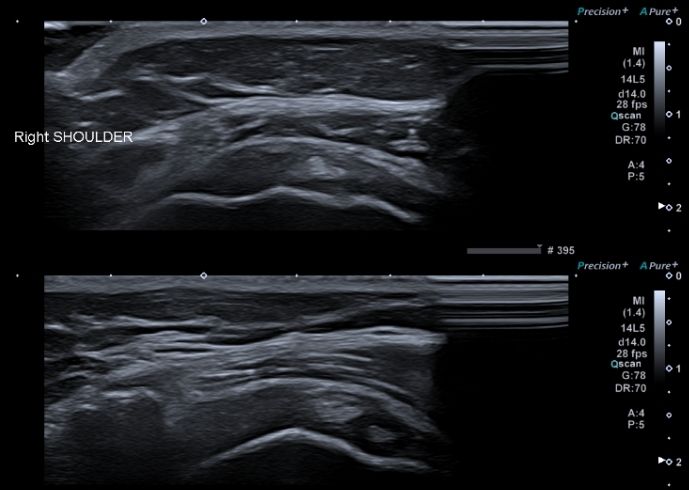
Osteoarticular ultrasound allows detailed observation of the joints and surrounding tissues, and is useful for identifying inflammation, joint effusion or changes in the synovial membrane. It can also detect muscle injuries, tendon and ligament tears or degeneration, bursitis and cysts. Using Doppler, it is possible to assess local blood flow, helping in the diagnosis of active inflammation.
This exam is also important in the assessment of sports injuries, in the study of osteoarthritis and arthritis, and in the follow-up of chronic rheumatic diseases.
In which cases is it indicated?
Osteoarticular ultrasound may be requested in several situations, such as:
- Pain or swelling in a joint;
- Muscle or tendon injuries;
- Sports trauma;
- Suspected tendon or ligament tears;
- Investigation of bursitis, cysts or soft-tissue masses;
- Assessment of arthritis and rheumatic diseases;
- Monitoring of osteoarthritis and other degenerative conditions;
- Guidance of procedures such as injections or joint aspirations;
- Among others.
Preparing for an Osteoarticular Ultrasound
This exam does not require any prior preparation.
You should simply bring any related previous exams (ultrasounds, X-rays, MRI scans or medical reports) and the exam prescription.
Where to have it done?
Osteoarticular ultrasound can be performed at X-Clinic (Av. Eng. Duarte Pacheco, nº26 – mezzanine floor, 1070-110 Lisbon) or at NRD (Avenida Columbano Bordalo Pinheiro, nº 11-B, ground floor, 1070 – 060 Lisbon – next to Praça de Espanha)
